
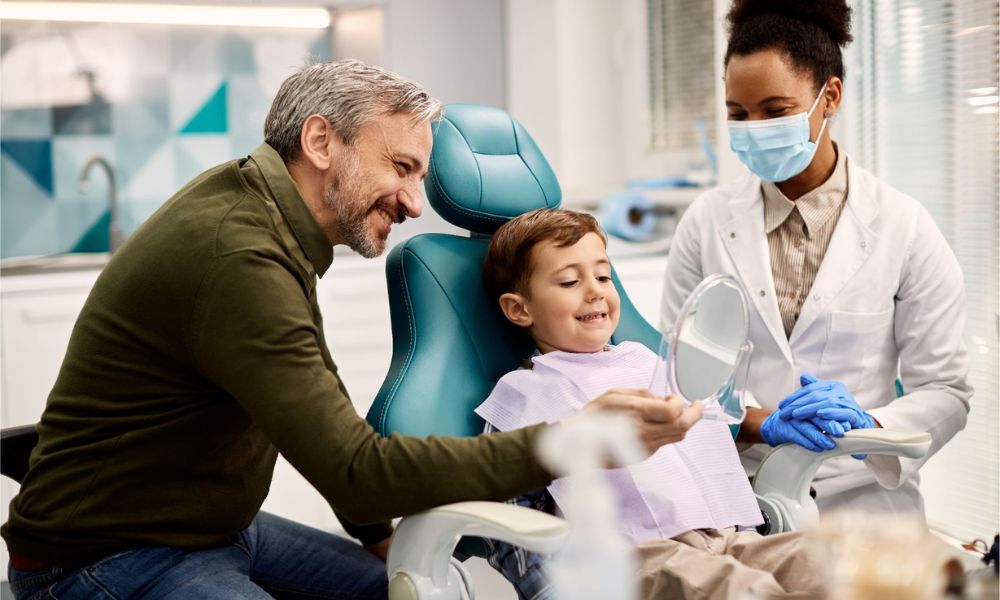
For parents, it can be challenging to determine which of their child’s dental issues require immediate attention from a paediatric dentist. Many issues are part of normal development.
Parents often spot chalky marks on new teeth, worry about wisdom teeth crowding, and feel unsure about braces, aligners and life after treatment.
Whether it’s understanding early childhood development, learning how to choose between braces and Invisalign Teen or knowing when to scan for wisdom teeth, you’ll find clear advice for your child’s next trip to the dentist.
Key Takeaways: Most paediatric dental decisions hinge on timing and habits. Prioritise timing, prevention, and simplicity; maintain regular check-ups; select age-appropriate orthodontics; and use conservative refinements only when necessary.
Common questions about paediatric dentistry
1. Are the tiny white spots on new adult teeth normal mineral patches or early decay?
According to a study of Australian children, Adult teeth first appear in most children between the ages of 6 and 8. At this stage of dental development, dental enamel is still maturing and remains more porous, resulting in an uneven enamel surface. They also pick up plaque more easily, especially near the gums.
When plaque bacteria feed on sugars, they make acids that lower pH and pull minerals from just under the enamel, causing early “white spot” changes. However, the surface is still intact, so simple habits can reverse this.
If a spot is chalky, matte, near the gums, getting bigger, or feels rough, it is time for a trip to the dentist.
2. How often should we schedule white-spot checks at this age?
Book routine dental checkups twice a year. That interval can be stretched to 12 months for very low-risk children or shortened to 3–6 months if risk rises. Take baseline photos when new teeth erupt, then recheck at 6–12 months.
Review every 3–4 months until the areas look glossy and stable. Your dentist will also offer advice on brushing, flossing and other oral hygiene techniques.
Common questions about early teenage dentistry
3. Should we scan now to predict wisdom-tooth crowding?
Wisdom teeth usually start forming around 7 to 10 years and eruption is most often around 18 to 25. A panoramic X-ray can be useful in the early to mid-teens when clinically indicated, but routine imaging without a reason is not recommended.
When a scan is needed, dental X-rays can answer specific questions, such as limited space, pain, recurrent swelling or wisdom teeth growing at an awkward angle. Evidence on this topic remains mixed, with one study concluding that there is inadequate evidence to justify removing wisdom teeth solely to prevent crowding relapse. However, this will need to be discussed with your paediatric dentist.
4. If we extract wisdom teeth early, will my child need temporary retainers?
Most teens do not need a temporary retainer after wisdom tooth surgery. If your child already wears braces, aligners or a retainer, a temporary retainer can help accommodate them.
5. Is my child a good candidate for phase-1 aligners?
Invisalign phase-1 aligners can be a good start for the right problems, and your child wears them consistently. These are clear, removable aligners used while a child still has a mix of baby and adult teeth, to gently guide growth and create space for incoming teeth.
The idea should be to assess gently and thoroughly, looking for early issues such as crossbite, narrow arches, crowding at the front, deep bite, or growth-impacting habits.
Your paediatric dentist will also check gum health and teeth brushing habits. If aligners are a good fit, they will take a quick digital scan, set clear goals and map a simple plan with reviews and likely timelines.
6. Should my child wear full braces or opt for Invisalign® Teen?
Choosing between full braces and Invisalign® Teen comes down to goals, lifestyle and how much your teen will wear their aligners. Invisalign Teen is clear and removable for meals, sports, and brushing, and works well for mild to moderate crowding and many bite issues.
Full braces are fixed, so they do not rely on wear time, and they are excellent for complex movements such as severe rotations, vertical changes, and guiding impacted teeth.
7. At what age should I start braces?
An early check around seven lets your dentist guide jaw growth and create space, often leading to simpler treatment later and fewer extractions.
Beginning full braces when the adult teeth are in, usually between eleven and fourteen, uses natural growth to move teeth more efficiently, shorten treatment, and improve bite function.
8. What is the difference between metal braces and clear aligner options for an active teen?
Metal braces are good for complex tooth movements. They are the most visible and need careful cleaning. Some foods are off the menu to avoid broken brackets. A proper sports mouthguard is important for contact activities.
A 2024 study comparing Invisalign with metal braces pooled 10 comparative studies and found that both approaches move teeth effectively to similar degrees, but Invisalign tended to finish treatment in a statistically shorter overall time. In practice, that means choosing between aligners and braces should focus on case complexity and how reliably a teen will wear aligners, not speed alone.
Clear aligners are almost invisible and removable. If your teenager is active or not a very diligent brusher, there are clear benefits to using these aligners. They’re also easier to clean, which suits busy schedules.
However, similarly to metal braces, clear aligners are typically worn for 20 to 22 hours a day. On top of that, very complex movements may still be faster with fixed braces, so it’s not an option for every teenager.
Conclusion
Most parent questions ultimately come down to timing, safety, and establishing steady oral hygiene habits for your child. Watch for chalky, matte patches near the gums. Keep up with regular dental checkups and start orthodontics once adult teeth are in. If you’re unsure, check with your dentist.
At Bondi Family Dentist, the aim is calm, evidence-based care that protects growing smiles, keeps treatment as simple as possible, and gives parents clear next steps. Schedule a friendly check-up for a comprehensive overview of your child’s oral health.


